|
Approaching Stein, Approaching Tender Buttons
My friend and Stein expert, Karren Alenier, asked a select group of poets to write response poems to each poem in Gertrude Stein's Tender Buttons. I initially said no because I didn't think I understood Tender Buttons well enough to write a response.
I first encountered Tender Buttons when taking a MOOC (massive open online class). The class was Modern American Poetry (affectionately called MODPO for short) taught by Al Filreis at the University of Pennsylvania. The class was helpful on putting a label on the major poetry movements of the 20th century.
I initially tried to read Tender Buttons but gave up because I couldn’t make any sense of it, even with the help of the class lectures. I did find a very good Libravox recording on You Tube. https://tinyurl.com/2efb29rf I could hear that the poem made sense to the actor if not to me. The actor performed with cohesion and clarity, indicating comprehension was there to be found or at least uncovered.
I decided to see if I could come up with an understanding, the caveat being that like most things in my life, I knew it would take discipline and work. I spent several months reading Tender Buttons and reading about Tender Buttons as well as watching lectures on it. I also peered into The Autobiography of Alice B. Toklas, Stein’s most accessible, and dare I say it, “fun” work. I learned some personal details about those dinner parties Alice was famous for, such as the seating arrangement. The walls contained paintings of some of the most famous artists of the day. When said painter would come to dinner Alice would seat him where he could easily see his painting. This detail ended up in my poem.
All excellent writers require that you relearn how to read, relearn how to understand, how to comprehend in order to appreciate their work. What I found with Stein is that way I usually read poetry doesn’t work with Tender Buttons. What did help me was free association. There are words and themes that reoccur in the poem. I found that after repeated readings I began to make connections where previously there were none. I remember being in a fiction class when the teacher said: There is this dirty little secret about reading classics. After awhile your subconscious begins to understand it, begins to connect ideas before you realize it. I ditto that. There is a qualifier I think. You have to be engaged and it takes time. Often the reader gives up before the enlightenment.
Well, after a couple of months of this foray into the belly of Tender Buttons, I have come up with five takeaways on Tender Buttons.
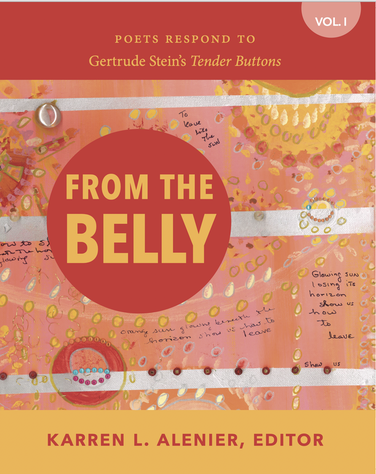
So after this time of study and research, this time of probing and probation, thinking and rethinking, I gathered a grasp of mine own understanding, and wrote a poem from Alice’s perspective—Setting The Table, which is included in From the Belly: Poets Respond to Gertrude Stein’s Tender Buttons.
The anthology is a lovely, loving exploration into the landscape of Tender Buttons with each poem prefaced by the Stein poem on the opposite page. tinyurl.com/ycxfvk8u
Poetry Mutual, a website dedicated to honoring poetry in the Washington Metropolitan Area, has declared From The Belly as one of the three best poetry anthologies of 2023. tinyurl.com/4r6f57zu
My friend and Stein expert, Karren Alenier, asked a select group of poets to write response poems to each poem in Gertrude Stein's Tender Buttons. I initially said no because I didn't think I understood Tender Buttons well enough to write a response.
I first encountered Tender Buttons when taking a MOOC (massive open online class). The class was Modern American Poetry (affectionately called MODPO for short) taught by Al Filreis at the University of Pennsylvania. The class was helpful on putting a label on the major poetry movements of the 20th century.
I initially tried to read Tender Buttons but gave up because I couldn’t make any sense of it, even with the help of the class lectures. I did find a very good Libravox recording on You Tube. https://tinyurl.com/2efb29rf I could hear that the poem made sense to the actor if not to me. The actor performed with cohesion and clarity, indicating comprehension was there to be found or at least uncovered.
I decided to see if I could come up with an understanding, the caveat being that like most things in my life, I knew it would take discipline and work. I spent several months reading Tender Buttons and reading about Tender Buttons as well as watching lectures on it. I also peered into The Autobiography of Alice B. Toklas, Stein’s most accessible, and dare I say it, “fun” work. I learned some personal details about those dinner parties Alice was famous for, such as the seating arrangement. The walls contained paintings of some of the most famous artists of the day. When said painter would come to dinner Alice would seat him where he could easily see his painting. This detail ended up in my poem.
All excellent writers require that you relearn how to read, relearn how to understand, how to comprehend in order to appreciate their work. What I found with Stein is that way I usually read poetry doesn’t work with Tender Buttons. What did help me was free association. There are words and themes that reoccur in the poem. I found that after repeated readings I began to make connections where previously there were none. I remember being in a fiction class when the teacher said: There is this dirty little secret about reading classics. After awhile your subconscious begins to understand it, begins to connect ideas before you realize it. I ditto that. There is a qualifier I think. You have to be engaged and it takes time. Often the reader gives up before the enlightenment.
Well, after a couple of months of this foray into the belly of Tender Buttons, I have come up with five takeaways on Tender Buttons.
- A Love Poem Written in Code. It was written in 1914. Not a great time to be public about same sex relations anywhere. Ambiguity and abstraction is a good way to pass the censor, whether the censor is society or the government or both.
- Cubist Poetics. At one time Gertrude Stein and her brother owned the largest collection of Picassos in France. He did a portrait of her which required numerous sittings--eighty or ninety, she said. They would talk of his painting philosophy and creativity in general. Tender Buttons was Steins’ attempt to put into words what the cubists were putting into paint.
- Playing with Words/Wordplay. “A coat, a coat of many colors, a coat is only as vibrant as its wearer.” Stein is the master of repetition. “A rose is a rose is a rose.” She loves the sound of words. She loves playing with words. And you also find rhyme. "Kind" and "cousin" in the opening lines. Okay, that's a slant rhyme, but it’s still a rhyme.
- Words as Symbols. By repeating words over and over again they start to lose their original meaning and acquire new meaning. “Little” appears ninety times. “Differ” and “different” occur twenty-four times. Some form of “to be” over a thousand. I think of Hamlet, of course. Is there no greater existential poem than “to be or not to be”? Is there no greater question?
- How We See. By forcing the reader to see things in a way that things are not usually perceived, the reader must abandon his previous way of looking and understanding. Is this not the essence of Picasso? Stein says, “Claiming nothing, not claiming anything, not a claim in everything, collecting claiming, all this makes a harmony, it even makes a succession.”
So after this time of study and research, this time of probing and probation, thinking and rethinking, I gathered a grasp of mine own understanding, and wrote a poem from Alice’s perspective—Setting The Table, which is included in From the Belly: Poets Respond to Gertrude Stein’s Tender Buttons.
The anthology is a lovely, loving exploration into the landscape of Tender Buttons with each poem prefaced by the Stein poem on the opposite page. tinyurl.com/ycxfvk8u
Poetry Mutual, a website dedicated to honoring poetry in the Washington Metropolitan Area, has declared From The Belly as one of the three best poetry anthologies of 2023. tinyurl.com/4r6f57zu
PRAISE FOR PORT OF LEAVING
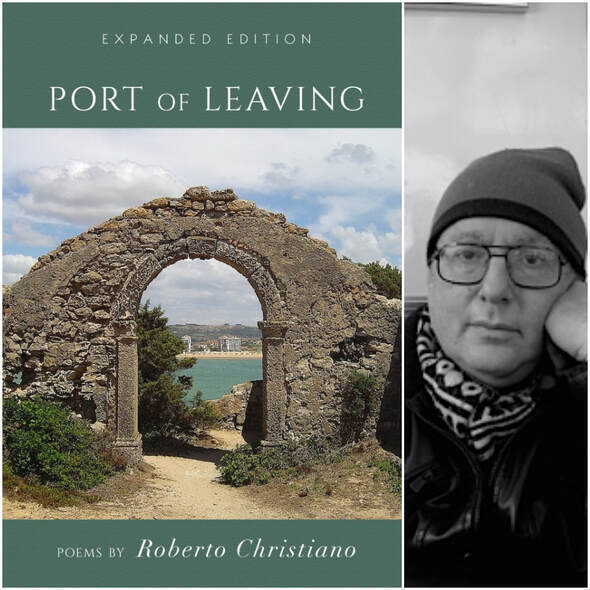
Port of Leaving explores what is lost in the difficult edges between continents and generations. Reaching back from the United States to Portugal, the poet repeatedly encounters the tragedies and injustices that have wounded and silenced historians, family. His gift to his readers in this honest and generous book is to show us, viscerally, how poetry itself can create those lost connections and help to heal those long-remembered wounds.
Annie Finch, author, The Poetry Witch Little Book of Spells
Americans are notorious for having short memories. That is why it was the American, William Faulkner, who had to say, “The past isn’t dead; the past isn’t even past.” But memory is a double-edged sword. It can give continuity and context but it can also keep us making the same mistakes over and over again; it can hold us back from necessary change. This dilemma is so perfectly portrayed in Robert Christiano’s full-length poetry collection, Port of Leaving.
Anne Becker, Poet Laureate Emerita of Takoma Park, Maryland
Port of Leaving by Roberto Christiano is a compelling journey of self-examination that opens out to the world we live in. It is a song in the fado tradition—a tradition that Christiano willingly shares.
Karren Alenier, Poet and Critic, review in The Dressing
Port of Leaving is on sale Finishing Line Press. tinyurl.com/2p96ddzm
Port of Leaving explores what is lost in the difficult edges between continents and generations. Reaching back from the United States to Portugal, the poet repeatedly encounters the tragedies and injustices that have wounded and silenced historians, family. His gift to his readers in this honest and generous book is to show us, viscerally, how poetry itself can create those lost connections and help to heal those long-remembered wounds.
Annie Finch, author, The Poetry Witch Little Book of Spells
Americans are notorious for having short memories. That is why it was the American, William Faulkner, who had to say, “The past isn’t dead; the past isn’t even past.” But memory is a double-edged sword. It can give continuity and context but it can also keep us making the same mistakes over and over again; it can hold us back from necessary change. This dilemma is so perfectly portrayed in Robert Christiano’s full-length poetry collection, Port of Leaving.
Anne Becker, Poet Laureate Emerita of Takoma Park, Maryland
Port of Leaving by Roberto Christiano is a compelling journey of self-examination that opens out to the world we live in. It is a song in the fado tradition—a tradition that Christiano willingly shares.
Karren Alenier, Poet and Critic, review in The Dressing
Port of Leaving is on sale Finishing Line Press. tinyurl.com/2p96ddzm
Two Poems from Port of Leaving
MY FATHER IS A BRICKLAYER
Driving through Georgetown
on a congested Friday afternoon,
I find myself stopped
behind a truckload of bricks
when my father comes to me--
red brown in his Portuguese skin.
"I'm a bricklayer by trade,"
he often says,
and his hands show it--
all calloused like tree bark.
I can drive through my hometown
and show you the homes
he built with those hands and arms
and a back that bent
as he spread the mortar.
"I built my own house,"
he says, and he did--
built it with swelter
and sinewy muscle,
built it so well
that it would take
a doomsday earthquake
to crack it down.
My father is a bricklayer.
He is a house built
with an invincible frame--
filled with bricks and mortar.
So as I drive down M street
and turn right up Wisconsin,
scuttling to another appointment
in another office,
I look in the rear view window
and adjust the earring in my ear.
I'm a different man than Father,
but I can't pass a truck of brick,
or a brick sidewalk, or a brick anything,
without thinking how much I am like him.
THE PAST IS NEVER DEAD
March returns like memory
and memory aches to be framed
in a melting rivulet of beauty.
But memorials are for the dead
and the dead leave nothing unsaid.
They talk through whispers,
through shrouds and shrugs,
through minds and messages,
through words, words, words.
The snow on the asphalt has melted.
What’s left is black with grime and dirt and stone.
The revenants return with the pelting rain.
The revenants return again and again.
Let us take out our teacups and sit in the Florida room.
I’ll pour the tea, my friend, and dispel the Virginia gloom.
Let us switch and talk of Trump and Salazar.
Let us tie our ties and swing on a swing.
The Potomac River is alive with budding cherry trees.
Psychic Bob, the medium on YouTube,
draws the curtains closed with a hush,
shuts his eyes, communes with the nether world,
flutters his lids, instinctively grabs the bag
of runes and throws them over a black cloth.
“The way is blocked. The road is covered.
Derecho, tornado, or winter storm.
There is no way out except through the cemetery.”
“Father, what happened to the Jews?”
On Nine-eleven the sky was blue.
And then there are the other martyrs:
the young gay man strung up like Christ,
the Portuguese shoeshine boy drowned,
the Capital guards hunted and downed,
the cigarette seller shot, the Mexican bound,
that woman from the mosque defaced.
Hush! Good Friday happens every week.
“Father, what happened to the Jews?”
And my father, red brown in his Portuguese skin,
tired from laying brick in the sun,
rubs his worn out hands and says,
“Portugal was under Salazar
and there was nothing we could do,
and all I wanted was to find America.
It’s what we all wanted—to be free.”
March is the mysterious month.
Mostly dead and fully alive.
Each day unpredictable as ice.
MY FATHER IS A BRICKLAYER
Driving through Georgetown
on a congested Friday afternoon,
I find myself stopped
behind a truckload of bricks
when my father comes to me--
red brown in his Portuguese skin.
"I'm a bricklayer by trade,"
he often says,
and his hands show it--
all calloused like tree bark.
I can drive through my hometown
and show you the homes
he built with those hands and arms
and a back that bent
as he spread the mortar.
"I built my own house,"
he says, and he did--
built it with swelter
and sinewy muscle,
built it so well
that it would take
a doomsday earthquake
to crack it down.
My father is a bricklayer.
He is a house built
with an invincible frame--
filled with bricks and mortar.
So as I drive down M street
and turn right up Wisconsin,
scuttling to another appointment
in another office,
I look in the rear view window
and adjust the earring in my ear.
I'm a different man than Father,
but I can't pass a truck of brick,
or a brick sidewalk, or a brick anything,
without thinking how much I am like him.
THE PAST IS NEVER DEAD
March returns like memory
and memory aches to be framed
in a melting rivulet of beauty.
But memorials are for the dead
and the dead leave nothing unsaid.
They talk through whispers,
through shrouds and shrugs,
through minds and messages,
through words, words, words.
The snow on the asphalt has melted.
What’s left is black with grime and dirt and stone.
The revenants return with the pelting rain.
The revenants return again and again.
Let us take out our teacups and sit in the Florida room.
I’ll pour the tea, my friend, and dispel the Virginia gloom.
Let us switch and talk of Trump and Salazar.
Let us tie our ties and swing on a swing.
The Potomac River is alive with budding cherry trees.
Psychic Bob, the medium on YouTube,
draws the curtains closed with a hush,
shuts his eyes, communes with the nether world,
flutters his lids, instinctively grabs the bag
of runes and throws them over a black cloth.
“The way is blocked. The road is covered.
Derecho, tornado, or winter storm.
There is no way out except through the cemetery.”
“Father, what happened to the Jews?”
On Nine-eleven the sky was blue.
And then there are the other martyrs:
the young gay man strung up like Christ,
the Portuguese shoeshine boy drowned,
the Capital guards hunted and downed,
the cigarette seller shot, the Mexican bound,
that woman from the mosque defaced.
Hush! Good Friday happens every week.
“Father, what happened to the Jews?”
And my father, red brown in his Portuguese skin,
tired from laying brick in the sun,
rubs his worn out hands and says,
“Portugal was under Salazar
and there was nothing we could do,
and all I wanted was to find America.
It’s what we all wanted—to be free.”
March is the mysterious month.
Mostly dead and fully alive.
Each day unpredictable as ice.
A BRIEF BIO
I started out my artistic life as a child actor and ended up as a writer. Along the way other arts became involved: painting, photography, and music. So far I've been a church pianist, herbalist, editor, coach, gardener, and library technician. I hope to host many other identities before the run is over. I have been writing poems for 60 years. Sometime in the 90s, I decided to take it seriously and studied for several decades at The Writer’s Center of Bethesda followed by a few more years at Politics and Prose, the notable D.C. bookstore and literary hub. I still take classes from time to time. Among my many teachers were Pulitzer Prize winner Henry Taylor, formalist Annie Finch, and the Poet Laureate Emerita of Takoma Park, Maryland, Anne Becker. I enjoy writing in a variety of genres: fiction, poetry, drama. My poetry and fiction are continually published in literary journals, and my short plays have been produced at the Source Theatre in Washington, D.C. My poetry was included in the anthology, The Gávea-Brown Book of Portuguese-American Poetry. I was nominated for the Pushcart Prize for my poem, Why I Sang at Dinner, which originally appeared in Prairie Schooner. I won the 2010 Fiction Prize from The Northern Virginia Review for my story, The Care of Roses. In 2013, I was awarded two consecutive poetry awards from writer.org, the website of The Writer's Center of Bethesda and Poet Lore. (See Lightning Strikes Twice by scrolling further down.) I live in Springfield, Virginia, close enough to D.C. to be entertained but far enough away to remain sane.
I started out my artistic life as a child actor and ended up as a writer. Along the way other arts became involved: painting, photography, and music. So far I've been a church pianist, herbalist, editor, coach, gardener, and library technician. I hope to host many other identities before the run is over. I have been writing poems for 60 years. Sometime in the 90s, I decided to take it seriously and studied for several decades at The Writer’s Center of Bethesda followed by a few more years at Politics and Prose, the notable D.C. bookstore and literary hub. I still take classes from time to time. Among my many teachers were Pulitzer Prize winner Henry Taylor, formalist Annie Finch, and the Poet Laureate Emerita of Takoma Park, Maryland, Anne Becker. I enjoy writing in a variety of genres: fiction, poetry, drama. My poetry and fiction are continually published in literary journals, and my short plays have been produced at the Source Theatre in Washington, D.C. My poetry was included in the anthology, The Gávea-Brown Book of Portuguese-American Poetry. I was nominated for the Pushcart Prize for my poem, Why I Sang at Dinner, which originally appeared in Prairie Schooner. I won the 2010 Fiction Prize from The Northern Virginia Review for my story, The Care of Roses. In 2013, I was awarded two consecutive poetry awards from writer.org, the website of The Writer's Center of Bethesda and Poet Lore. (See Lightning Strikes Twice by scrolling further down.) I live in Springfield, Virginia, close enough to D.C. to be entertained but far enough away to remain sane.

A HAIKU JOURNEY TO THE WASHINGTON POST
Poetry Readers,
It seems like an age ago that I sent my first batch of
haiku to Frogpond, the magazine of the Haiku Society
of America, and received my worst rejection ever. "These aren't even close," the editor, a famous haiku poet, wrote back. In retrospect I should thank him, because in that moment, I decided that I would continue to write haiku and that they would be published.
Ten years later Paper Wasps, a haiku magazine in Australia, published two. I remember this one.
she arches on the sill--
my cat doing cat pose
Frogpond never published me. However, a subsequent editor offered some helpful criticism. She said the current vogue was that haiku in English should be 21 syllables or less. John Kelly, The Washington Post editor, is a little more old school--three lines, 5, 7, 5 syllables--what we were all taught in school. Other teachers abandon syllable count altogether.
This journey has taken some interesting turns. I remember going to the Museum of Natural History to do a workshop on Haiku taught by my mentor Anne Becker. I was surprised and embarrassed to be surrounded by elementary school age children. I was the only adult. The embarrassment was short lived because, well, I like kids. And then too, I learned something. Children easily take to haiku while adults often struggle, and not just with syllables.
Haiku, traditionally, is more than a syllable count. There's also the choice of season, a selection of emotion, a layering of imagery, and the arrangement of words on a page. Of course, these tenets are just scratching the surface. The more you enter in the art the more complex and elusive it becomes.
In the workshop with the kids, I also learned the concept of comparing something small in nature with something large. I wrote:
under a microscope
a teaspoon of sand
becomes a zen rock garden
A turning point came when I entered John Kelly's Springtime in Washington Haiku contest in 2019 and was chosen as a finalist.
awake from winter
Tian Tian considers Mei Xiang
congress in session
I had arrived or at least found a water post. This haiku was inspired by our national panda obsession (our pandemonium) and the idea of viewing our congressional shenanigans as a mating ritual.
And then in 2021, I entered the contest again.:
We try for a first date
and meet at Dumbarton Oaks
We keep our masks on
Once again a finalist. Always a bridesmaid, never the blushing significant other. I wish I could say this haiku was autobiographical. Maybe that should be my next goal. It is rather based on my many trips to the gardens at Dumbarton Oaks in Georgetown, the pandemic, and my fertile if somewhat dramatic imagination, sprinkled with my odd sense of humor.
In the midst of the shutdown my haiku path continued. Last year I took a workshop on the tanka from The Poetry Foundation. Haiku developed out of tanka which is two lines longer. About the same time as the class, I had a very pleasant bit of synchronicity, I discovered my BFF's Japanese aunt was raised by one of the most famous women haiku poets of the 20th century--Tatsuko Hoshino. That makes only two degrees of separation. In commemoration of this coincidence, I wrote her aunt these tankas as a Christmas present.
Tankas Late in Advent
(for Aunt Etsuko)
No predictions of
snowfall for Christmas this year--
only the cold rain
snapping at our heads and heels
as we hurry home to sigh.
Why did Jesus have
to come at this time of year
when the days are short
and tempers even shorter
and purses thin as paper?
The amaryllis
on my kitchen table grows
and blooms, a yearly
miracle that comes to light
in spite of the daily news.
I included the following note with this present: I try not to steer too far away from the Japanese observation of nature--what it offers, what it has to say, what it chooses not to say, what mystery is embedded in the everyday experience of the seasons, what are the images, what are the emotions, and where is the humor. Surely we need this now more than ever.
Ars Poetica,
Roberto Christiano
Poetry Readers,
It seems like an age ago that I sent my first batch of
haiku to Frogpond, the magazine of the Haiku Society
of America, and received my worst rejection ever. "These aren't even close," the editor, a famous haiku poet, wrote back. In retrospect I should thank him, because in that moment, I decided that I would continue to write haiku and that they would be published.
Ten years later Paper Wasps, a haiku magazine in Australia, published two. I remember this one.
she arches on the sill--
my cat doing cat pose
Frogpond never published me. However, a subsequent editor offered some helpful criticism. She said the current vogue was that haiku in English should be 21 syllables or less. John Kelly, The Washington Post editor, is a little more old school--three lines, 5, 7, 5 syllables--what we were all taught in school. Other teachers abandon syllable count altogether.
This journey has taken some interesting turns. I remember going to the Museum of Natural History to do a workshop on Haiku taught by my mentor Anne Becker. I was surprised and embarrassed to be surrounded by elementary school age children. I was the only adult. The embarrassment was short lived because, well, I like kids. And then too, I learned something. Children easily take to haiku while adults often struggle, and not just with syllables.
Haiku, traditionally, is more than a syllable count. There's also the choice of season, a selection of emotion, a layering of imagery, and the arrangement of words on a page. Of course, these tenets are just scratching the surface. The more you enter in the art the more complex and elusive it becomes.
In the workshop with the kids, I also learned the concept of comparing something small in nature with something large. I wrote:
under a microscope
a teaspoon of sand
becomes a zen rock garden
A turning point came when I entered John Kelly's Springtime in Washington Haiku contest in 2019 and was chosen as a finalist.
awake from winter
Tian Tian considers Mei Xiang
congress in session
I had arrived or at least found a water post. This haiku was inspired by our national panda obsession (our pandemonium) and the idea of viewing our congressional shenanigans as a mating ritual.
And then in 2021, I entered the contest again.:
We try for a first date
and meet at Dumbarton Oaks
We keep our masks on
Once again a finalist. Always a bridesmaid, never the blushing significant other. I wish I could say this haiku was autobiographical. Maybe that should be my next goal. It is rather based on my many trips to the gardens at Dumbarton Oaks in Georgetown, the pandemic, and my fertile if somewhat dramatic imagination, sprinkled with my odd sense of humor.
In the midst of the shutdown my haiku path continued. Last year I took a workshop on the tanka from The Poetry Foundation. Haiku developed out of tanka which is two lines longer. About the same time as the class, I had a very pleasant bit of synchronicity, I discovered my BFF's Japanese aunt was raised by one of the most famous women haiku poets of the 20th century--Tatsuko Hoshino. That makes only two degrees of separation. In commemoration of this coincidence, I wrote her aunt these tankas as a Christmas present.
Tankas Late in Advent
(for Aunt Etsuko)
No predictions of
snowfall for Christmas this year--
only the cold rain
snapping at our heads and heels
as we hurry home to sigh.
Why did Jesus have
to come at this time of year
when the days are short
and tempers even shorter
and purses thin as paper?
The amaryllis
on my kitchen table grows
and blooms, a yearly
miracle that comes to light
in spite of the daily news.
I included the following note with this present: I try not to steer too far away from the Japanese observation of nature--what it offers, what it has to say, what it chooses not to say, what mystery is embedded in the everyday experience of the seasons, what are the images, what are the emotions, and where is the humor. Surely we need this now more than ever.
Ars Poetica,
Roberto Christiano

The audacious poetry zine, Limp Wrist, has released their villanelle issue.. I have a nickname for this form. Villanelle--The Form From Hell. They are très difficult to write. They must rhyme, have two repeating lines, and preferably be in meter. The editor, Beth Gylys, said mine,Telenovelas are Hell, was perfect. It's not--I find meter a difficult lion to tame but of course I appreciate the flattery. I wrote it when I took a class on villanelles at Politics and Prose taught by Annie Finch. Check it out. www.limpwristmagazine.com/lw4toc

The Amethyst Review
New Writing Engaging With The Sacred
The Way to Holy Cross: tinyurl.com/e6mc65bm
The Cardinal: tinyurl.com/mtvscrfz
This online zine, which explores the intersection of literature and the divine, accepted two of my poems. The Cardinal appeared last spring, The Way to Holy Cross last fall. This is particularly marvelous as both poems were passed over for publication many many times. The spring poem I revised for ten years, The fall poem I revised for twenty. Each rejection offered a space for reevaluation.
New Writing Engaging With The Sacred
The Way to Holy Cross: tinyurl.com/e6mc65bm
The Cardinal: tinyurl.com/mtvscrfz
This online zine, which explores the intersection of literature and the divine, accepted two of my poems. The Cardinal appeared last spring, The Way to Holy Cross last fall. This is particularly marvelous as both poems were passed over for publication many many times. The spring poem I revised for ten years, The fall poem I revised for twenty. Each rejection offered a space for reevaluation.
October 2020 in The New Verse News
tinyurl.com/3a5xjcae
My poem, October 2020, was featured in The New Verse News, a site dedicated to political poetry. I wrote the poem in response to hearing an increasing amount of sirens in my neighborhood. I also wrote the poem to fit an exercise for a class I was taking called The Poet's Ear where the assignment was to compose some verse in falling meter (trochaic). As you can guess from the title, falling meter seems appropriate for the year, what with the plague and all.
tinyurl.com/3a5xjcae
My poem, October 2020, was featured in The New Verse News, a site dedicated to political poetry. I wrote the poem in response to hearing an increasing amount of sirens in my neighborhood. I also wrote the poem to fit an exercise for a class I was taking called The Poet's Ear where the assignment was to compose some verse in falling meter (trochaic). As you can guess from the title, falling meter seems appropriate for the year, what with the plague and all.
And The Stars Were Shining
tinyurl.com/8hnff878
My personal essay, And The Stars Were Shining, originally published in Delmarva Review, has been republished in three local news journals--The Talbot Spy, The Chestertown Spy, and The Annapolis Spy. I was asked to write a brief introduction to the piece. Here's an excerpt:
Because I am fortunate enough to have my 96-year-old mother with me, I find that I have a viable passport into another time, another place, another country, a viable portal to Italy in the first half of the twentieth century. There are stories in my family that are too good not to tell—passionate tales both ordinary and extraordinary. From such a true vein was this essay written.
tinyurl.com/8hnff878
My personal essay, And The Stars Were Shining, originally published in Delmarva Review, has been republished in three local news journals--The Talbot Spy, The Chestertown Spy, and The Annapolis Spy. I was asked to write a brief introduction to the piece. Here's an excerpt:
Because I am fortunate enough to have my 96-year-old mother with me, I find that I have a viable passport into another time, another place, another country, a viable portal to Italy in the first half of the twentieth century. There are stories in my family that are too good not to tell—passionate tales both ordinary and extraordinary. From such a true vein was this essay written.
|
My Fib
My poem, the irrational, based on the Fibonacci Sequence is included in the poetry zine--Intersections--Poetry With Mathematics. The sequence, originally set forth in 1202 by the Italian mathematician, Leonardo de Pisa, also known as Fibonacci, is a number pattern often seen in nature, or as popularly believed, in the multiplication of rabbits. The poem was originally published in the fib review which only publishes poems using the Fibonacci Sequence. the irrational: tinyurl.com/y422z6t7 the fib review: tinyurl.com/y7gzqbms |

|
I am somewhat surprised by this turn of events as my math level is around 8th grade. Even adding a tip to a check is hard for me. (Yes, I now have the app for that.)
The poem contains a Hamlet reference. It is a play I know well. I played Guildenstern in the Washington Shakespeare's Company production. The phrase in my poem, heaven and earth, echoes Hamlet's soliloquy where he says, heaven and earth, must I remember. After encountering his father's ghost, Hamlet is caught between the "real" world and the spiritual world. You could say it's Elizabethan existentialism.
The poem contains a Hamlet reference. It is a play I know well. I played Guildenstern in the Washington Shakespeare's Company production. The phrase in my poem, heaven and earth, echoes Hamlet's soliloquy where he says, heaven and earth, must I remember. After encountering his father's ghost, Hamlet is caught between the "real" world and the spiritual world. You could say it's Elizabethan existentialism.

|
Two Poems in Beltway Quarterly Review
bit.ly/38J9kmG The theme of the issue was Conserving Home. Two of my poems were selected. Since I've spent so much time in DC I consider it my home as well as Northern Virginia. Walking The River conveys much of my love for the area. |
The Northern Virginia Review
My story--Cape Code Evening, 1939--was in the 2019 issue of The Northern Virginia Review. The story was based on the painting of the same name by Edward Hopper. After spending hours with the painting this story emerged.
I am a regular fiction contributor to TNVR. The Northern Virginia Review Blog is here: tinyurl.com/y27n442q
My story--Cape Code Evening, 1939--was in the 2019 issue of The Northern Virginia Review. The story was based on the painting of the same name by Edward Hopper. After spending hours with the painting this story emerged.
I am a regular fiction contributor to TNVR. The Northern Virginia Review Blog is here: tinyurl.com/y27n442q
|
|
|
|
t Cape Cod Evening, 1939
published in The Northern Virginia Review
Excerpt:
“Roy, I’m going to visit my sister right after dinner. Don’t worry, I’ll clean the kitchen. Now there’s no use arguing. We’ve been through this I don’t know how many times. I promised Katie I’d visit for a year and today I’m going.”
Roy clapped his hands for their collie, Lady. A whippoorwill, startled by the clap, redoubled her flight and Lady followed.
“You can pout all you like. I’m going to walk down to the Talbot’s and Frank is driving me to the station.”
Roy’s eyes followed the dog.
“What’s the matter, cat got your tongue? You’re not stopping me this time.”
“Look at our girl go. Lady’s got her little bird.”
Edna sighed in exasperation. “Well, I’ll be back in a week. You won’t die in a week. Even if you think you will. You can always ask your nephew to help sow the remaining field. Jake’s a good boy. You’ll manage. You’re not helpless.”
She leaned against the house and peeled a slice of decaying white paint away from the window.
Lady returned panting, a feather hung loosely from the corner of her mouth.
“Good girl, Lady, good girl.”
Roy smacked the collie on her rump and looked at Edna.
published in The Northern Virginia Review
Excerpt:
“Roy, I’m going to visit my sister right after dinner. Don’t worry, I’ll clean the kitchen. Now there’s no use arguing. We’ve been through this I don’t know how many times. I promised Katie I’d visit for a year and today I’m going.”
Roy clapped his hands for their collie, Lady. A whippoorwill, startled by the clap, redoubled her flight and Lady followed.
“You can pout all you like. I’m going to walk down to the Talbot’s and Frank is driving me to the station.”
Roy’s eyes followed the dog.
“What’s the matter, cat got your tongue? You’re not stopping me this time.”
“Look at our girl go. Lady’s got her little bird.”
Edna sighed in exasperation. “Well, I’ll be back in a week. You won’t die in a week. Even if you think you will. You can always ask your nephew to help sow the remaining field. Jake’s a good boy. You’ll manage. You’re not helpless.”
She leaned against the house and peeled a slice of decaying white paint away from the window.
Lady returned panting, a feather hung loosely from the corner of her mouth.
“Good girl, Lady, good girl.”
Roy smacked the collie on her rump and looked at Edna.
PUSHCART NOMINEE (from Prairie Schooner)
WHY I SANG AT DINNER
I was not permitted a word at dinner
because you were too hot from laying
brick in the sun to bear the voices
of children, and mother too tired
to oppose you. My sister and brother,
five and six years older, had graduated
in allowance to one sentence
and on your good days two.
Sometimes I ventured a phrase
but you pushed me down quick.
“You no speak. You have no responsibility.”
The r in responsibility you would hit
with a rough Portuguese trill.
Your own father used to beat you
with a rope until you bled.
You vowed never to repeat this.
You had no need.
Still, I wanted to loosen the knot
between your brows and find
the soft place within you.
I watched how playing your accordion
for hours into the night soothed you.
Above the keys in gleaming silver
cursive was written Excelsior.
Since the accordion weighed too much
to pick up I began to sing--
often in the middle of dinner.
Slenderly, I quavered out tunes
you liked from Lawrence Welk.
Sometimes I just sang Excelsior.
No one said anything.
How could they?
I continued without looking up.
You neither stopped me nor softened.
One evening when I was thirteen I gave up.
My new male voice was starting to break in
and I couldn’t care anymore.
For a discussion of this poem by the prominent blogger Lisa Romeo go here: tinyurl.com/bdf89mzc
WHY I SANG AT DINNER
I was not permitted a word at dinner
because you were too hot from laying
brick in the sun to bear the voices
of children, and mother too tired
to oppose you. My sister and brother,
five and six years older, had graduated
in allowance to one sentence
and on your good days two.
Sometimes I ventured a phrase
but you pushed me down quick.
“You no speak. You have no responsibility.”
The r in responsibility you would hit
with a rough Portuguese trill.
Your own father used to beat you
with a rope until you bled.
You vowed never to repeat this.
You had no need.
Still, I wanted to loosen the knot
between your brows and find
the soft place within you.
I watched how playing your accordion
for hours into the night soothed you.
Above the keys in gleaming silver
cursive was written Excelsior.
Since the accordion weighed too much
to pick up I began to sing--
often in the middle of dinner.
Slenderly, I quavered out tunes
you liked from Lawrence Welk.
Sometimes I just sang Excelsior.
No one said anything.
How could they?
I continued without looking up.
You neither stopped me nor softened.
One evening when I was thirteen I gave up.
My new male voice was starting to break in
and I couldn’t care anymore.
For a discussion of this poem by the prominent blogger Lisa Romeo go here: tinyurl.com/bdf89mzc
The Ekphrastic Review
https://tinyurl.com/y8ju36t4
My poem, Saint Joseph and the Boy Jesus, is in 2018 edition of The Ekphrastic Review. Ekphrastic art is art that is inspired by other art--usually poetry inspired by paintings. For the last two years I have been attending the Writing Salons hosted by The National Gallery of Art in DC, where we use paintings as prompts for our writing. This poem appears in an earlier version in my chapbook, Port of Leaving, and is based on the painting of same name by the Baroque Portuguese painter, Josefa de Obidos. Although I saw a couple of her paintings when visiting Obidos, where she spent most of her life, I did not encounter this particular painting until I saw a retrospective of her work at the Museum of Women in the Arts in DC.
https://tinyurl.com/y8ju36t4
My poem, Saint Joseph and the Boy Jesus, is in 2018 edition of The Ekphrastic Review. Ekphrastic art is art that is inspired by other art--usually poetry inspired by paintings. For the last two years I have been attending the Writing Salons hosted by The National Gallery of Art in DC, where we use paintings as prompts for our writing. This poem appears in an earlier version in my chapbook, Port of Leaving, and is based on the painting of same name by the Baroque Portuguese painter, Josefa de Obidos. Although I saw a couple of her paintings when visiting Obidos, where she spent most of her life, I did not encounter this particular painting until I saw a retrospective of her work at the Museum of Women in the Arts in DC.
Published in Poetry Quarterly
Song of the Slaves*
Come bring your slaves, your fine black slaves,
for it’s Christmas time and Christ is near.
If you can’t buy them a trinket of gold
then at least let them look at the baby Jesus.
Come Miguel and Moses, Luis and Sheba,
Come and behold the Christmas cradle
where baby Jesus lies sleeping with sheep.
You know what it’s like to sleep in a stable.
The good father grins and greets them.
It’s Christmas time and it’s good to act
like a Christian at least once a year.
Besides, Jesus is sleeping in the cradle.
Miguel says, you go first. Moses says, you go.
Luis says, I’m not worthy, but Sheba says, I’ll go.
For Jesus is sleeping on Christmas day
and anyone can come and see a baby sleeping.
The father says, come near, come near.
Today anyone can pray to Jesus even
if he’s a baby in a cradle. Anyone
can make a Christmas wish on Jesus.
You speak, says Miguel. No you, says Moses,
Luis says, I can’t speak. I’ll speak, says Sheba,
What is your Christmas wish, asks the good father.
Our Christmas wish, says Sheba, is to be free.
*loosely based on a 17th century Portuguese madrigal
Come bring your slaves, your fine black slaves,
for it’s Christmas time and Christ is near.
If you can’t buy them a trinket of gold
then at least let them look at the baby Jesus.
Come Miguel and Moses, Luis and Sheba,
Come and behold the Christmas cradle
where baby Jesus lies sleeping with sheep.
You know what it’s like to sleep in a stable.
The good father grins and greets them.
It’s Christmas time and it’s good to act
like a Christian at least once a year.
Besides, Jesus is sleeping in the cradle.
Miguel says, you go first. Moses says, you go.
Luis says, I’m not worthy, but Sheba says, I’ll go.
For Jesus is sleeping on Christmas day
and anyone can come and see a baby sleeping.
The father says, come near, come near.
Today anyone can pray to Jesus even
if he’s a baby in a cradle. Anyone
can make a Christmas wish on Jesus.
You speak, says Miguel. No you, says Moses,
Luis says, I can’t speak. I’ll speak, says Sheba,
What is your Christmas wish, asks the good father.
Our Christmas wish, says Sheba, is to be free.
*loosely based on a 17th century Portuguese madrigal
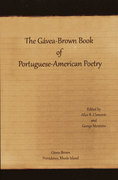
Gavea-Brown Book of Portuguese-American Poetry
I have been anthologized. Gavea-Brown, a publisher out of Brown University, has chosen my Pushcart nominated poem, Why I Sang At Dinner, along with four others, for this anthology.
http://tinyurl.com/kcjfo4y
back cover:
“…Give me your tired, your poor, your huddled masses yearning to breathe
free, the wretched refuse of your teeming shore.”
These words, engraved on a bronze plaque and mounted in the Statue of Liberty in 1903, have become emblematic of the American experience. They are the words of Emma Lazarus, a poet who like the twenty-three other poets represented in this anthology, could acknowledge, and at times perhaps even embrace, Portuguese roots while forging an indisputably American identity.
Portuguese-American poets are a varied group – in theme and style as well as in geographic distribution. What they have in common, in addition to the ancestral link, is that they are American poets. Their work falls within the traditions of the best of both worlds.
I have been anthologized. Gavea-Brown, a publisher out of Brown University, has chosen my Pushcart nominated poem, Why I Sang At Dinner, along with four others, for this anthology.
http://tinyurl.com/kcjfo4y
back cover:
“…Give me your tired, your poor, your huddled masses yearning to breathe
free, the wretched refuse of your teeming shore.”
These words, engraved on a bronze plaque and mounted in the Statue of Liberty in 1903, have become emblematic of the American experience. They are the words of Emma Lazarus, a poet who like the twenty-three other poets represented in this anthology, could acknowledge, and at times perhaps even embrace, Portuguese roots while forging an indisputably American identity.
Portuguese-American poets are a varied group – in theme and style as well as in geographic distribution. What they have in common, in addition to the ancestral link, is that they are American poets. Their work falls within the traditions of the best of both worlds.

SILK ROAD REVIEW
http://tinyurl.com/gm8n4yh
The 2017 winter issue of Silk Road Review includes my translation of the sixth century, Arabic poem, The Muallaqa, by Imru Al-Quays. The poem is entitled Stop and Let Us Weep, and is the fruit of a pre-Islamic poetry translation workshop I took with the preeminent translator Kareem James Abu-Zeid. This is my first translation to be published although I have so many translations of Sappho that I hope to bring forth in a book someday.
http://tinyurl.com/gm8n4yh
The 2017 winter issue of Silk Road Review includes my translation of the sixth century, Arabic poem, The Muallaqa, by Imru Al-Quays. The poem is entitled Stop and Let Us Weep, and is the fruit of a pre-Islamic poetry translation workshop I took with the preeminent translator Kareem James Abu-Zeid. This is my first translation to be published although I have so many translations of Sappho that I hope to bring forth in a book someday.

Lightning Strikes Twice
Double Winner of The Writer's Center Seasonal Awards
Twice in a row, I have won the Writer's Center seasonal writing award. The first time the contest theme was Halloween, and the second time was the winter holidays. My poem, Uncle Robbie at the Thanksgiving Table, is based on the musings of an uncle of mine who often appears in my poems.
Uncle Robbie at the Thanksgiving Table
It has taken a great deal of effort
to get my aunts and uncles
and first cousins in one place,
and now—at the dinner table,
it has taken even more effort
to get them to be quiet for grace.
I hold my aging aunt’s wrinkled hand
and my new niece’s unwrinkled one.
I quickly get in the prayer
before there’s an interruption,
and then afterwards--
there’s this silence--
an acknowledgement that we
are indeed family, that we
are actually related, and perhaps
even the pretense that we are one,
and if not one, at least united.
Then Uncle Robbie speaks:
“You know, yesterday, I reached
into the pocket of my jacket,
my blue one, not my grey one,
you know my grey one that I got
in the Lisbon airport in ’95,
and I found my schedule
for physical therapy. I had already
missed an appointment. I called
the office and asked them
if I had to pay for the appointment,
and they said I did, and a late charge
as well. Well, I said, how much
is the late charge, that’s what I want
to know. How much do you think
it was?”
There is no answer.
The buzz of talk has resumed
as the clatter of plates
and silverware fill the room.
Uncle Robbie drops physical
therapy and begins to expound
of the merits of the expensive
new bus station in East Hartford,
“A complete waste. It could
be spent on the homeless shelter.
But does anyone care,
does any care, I ask you?”
He says this with such force
that he blows out the candle
in front of him. I strike a match
and relight it and move the candle
away from him. He continues.
